
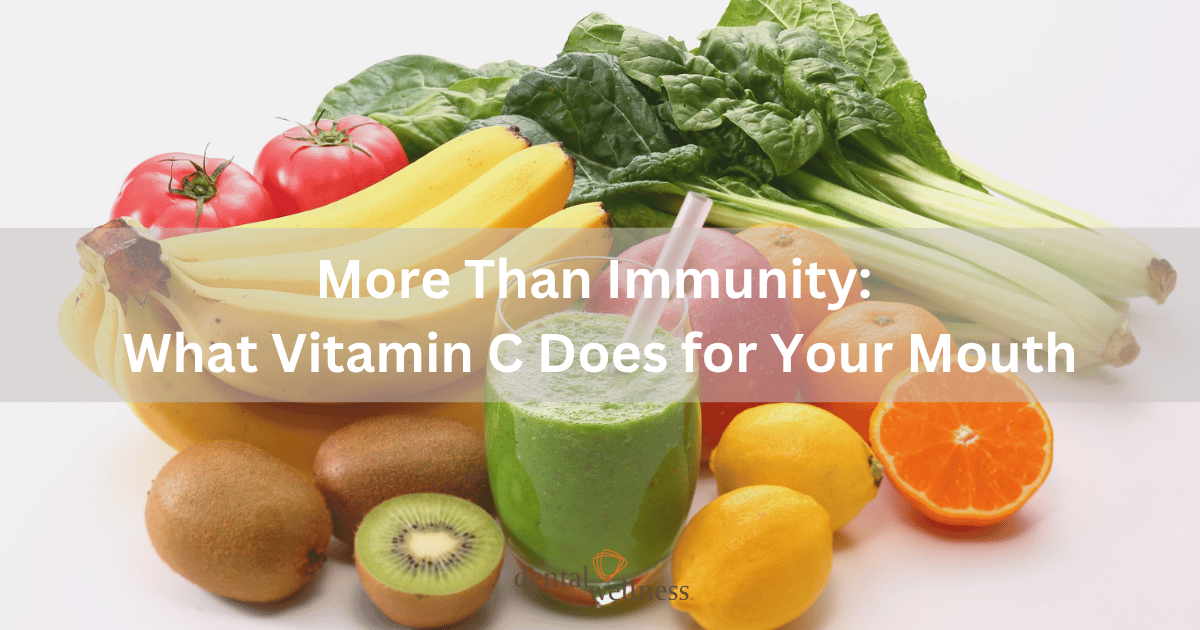
Vitamin C has a fixed place in most people’s minds: the cold-and-flu vitamin, the orange juice you reach for when winter sets in. That reputation is earned, but it’s also narrow. Long before vitamin C was understood as an immune helper, it announced itself in a far more specific place — the mouth.
The clearest illustration is scurvy, the disease of vitamin C deficiency that once haunted long sea voyages. Its earliest signs weren’t in the chest or the joints. They appeared at the gum line: tissue that turned soft and spongy, bled at the slightest touch, and eventually let teeth loosen and fall out. That history points to something easy to overlook — your gums depend on vitamin C in a direct, structural way. For anyone thinking about their oral health, or weighing up dental work, it’s worth understanding why.
What vitamin C is actually doing in your mouth
Start with the tissue itself. Gums are connective tissue, built largely from collagen — the protein that gives them their firmness and keeps them sealed snugly around each tooth. Here’s the part most people never hear: the body cannot make collagen without vitamin C. It’s not a supporting player in this process; it’s a required ingredient. When vitamin C runs short, collagen production falters, and the gums — collagen-rich and in constant use — are among the tissues that show it most plainly.
Vitamin C does a second job, too. In inflamed or healing tissue, it acts as an antioxidant, helping to settle the oxidative stress that comes with that territory. Both roles — building and calming — matter for a part of the body that is constantly under low-level challenge from the bacteria living in the mouth.
The research has begun to map this out. A 2024 meta-analysis published in BMC Oral Health pooled 23 observational studies covering more than 74,000 people and found that higher vitamin C intake was associated with lower odds of gum disease — a result that held up across multiple tests. Closer to home, a 2020 pilot study from an Australian periodontics clinic, published in Nutrients, found that patients with more advanced gum disease tended to have lower vitamin C levels and higher inflammatory markers in their blood. Intriguingly, those levels didn’t always match what people said they ate — blood tests can tell a different story than a food diary.
These are associations, not proof of cause and effect. But the link is biologically coherent, and it’s strongest exactly where you’d expect: inflammation, bleeding, and healing.
Food first, supplements with care
The first place to look is the plate, not the supplement aisle. Capsicum, citrus, kiwi fruit, broccoli and strawberries are all rich sources, and because vitamin C is fragile — broken down by heat and long storage — fresh, lightly cooked produce holds more of it than the same food overcooked or left to sit. The Australian study above is a useful nudge here: it’s not only whether you occasionally eat the fruit, but the steadier pattern over weeks that shows up.
The healing angle is where this gets practical. In a 2021 split-mouth trial published in the Journal of Oral Science, patients who had premolars removed served as their own controls — vitamin C was applied to one extraction site, none to the other. The treated sockets healed measurably better. For anyone facing an extraction or an implant, arriving with good vitamin C status is a small, sensible part of giving the body what it needs to recover well.
If you take regular medication, have a medical condition, or are heading toward surgery, it’s worth talking to your dentist or GP before adding a vitamin C supplement, rather than guessing on your own. Not everyone tolerates supplements well, and very high doses commonly cause diarrhoea and stomach upset — usually the body’s signal you’ve passed the point of any benefit. At sustained high doses, they can also raise the risk of kidney stones in people already prone to them. For most people, whole foods cover it without supplementing at all — and with vitamin C, as with most things, more is not automatically better.
Where this leaves you
A few situations shift the picture. Smoking depletes vitamin C, so smokers generally need more to reach the same level. People preparing for oral surgery have a clear, time-limited reason to pay attention. And if your diet is already varied and rich in fresh produce, the extra gain from supplementing is likely modest — it’s the shortfall, not the surplus, that matters most.
It’s worth being honest about the limits, too. Vitamin C supports healthy gums, aids healing, and is linked to lower disease risk — but on its own, it won’t rebuild lost bone or reverse advanced gum disease once that damage is established. Its real strength is in prevention, support and healing — which is no small thing.
None of this is news to the team at Dental Wellness — the link between what you eat and a healthy mouth sits at the centre of how the practice works. It’s also why Dr David built the 28-Day Oral FITNESS Reset Program: a day-by-day guide to nutrition, habits, and simple techniques that support better oral health, one step at a time. If you’d rather put these ideas into practice than just read about them, you can find the full program — currently discounted — by clicking HERE, or the banner just below.
It’s good for You!
Dr David Cowhig, the founder of the Dental Wellness clinics, is a pioneer in holistic metal free dentistry & aesthetics, providing scientific-based biological dentistry. We support you as an individual and take into account the variety of factors that can lead to dental and oral health problems. We believe passionately that creating health and beauty around us is an integral part of life and you will feel these qualities in our dental care. You can find us at The Gap in Brisbane, focussing on holistic aesthetic total metal-free dentistry.
Contact Dental Wellness on 07 3511 1399 or email [email protected].
Contact Us Today
We would love to hear from you.
Our mission is simple: we want to help you create a safer, healthy, beautiful smile.
Please call (07) 3511 1399 to reach our reception team who will do their best to address your concerns, answer your questions and book a convenient appointment. Alternatively, request your appointment online or send us a message and we'll get back to you as soon as possible.