Most people who’ve had a root canal treatment naturally assume the tooth is fixed — the infection dealt with, the problem behind them. That’s a reasonable assumption. Why else would someone go through the procedure? Yet a growing number of dentists are recognising that root canal treatment is not always as straightforward as it appears, a position increasingly supported by research. And some patients with root-canal-treated teeth find themselves wondering why certain aspects of their overall health picture haven’t quite added up.
Understanding what actually happens inside a root-canal-treated tooth — and how it may connect to the rest of the body — is the kind of knowledge that puts patients in a genuinely informed position to make the best decisions for their health.
A Dead Tooth in a Living Body
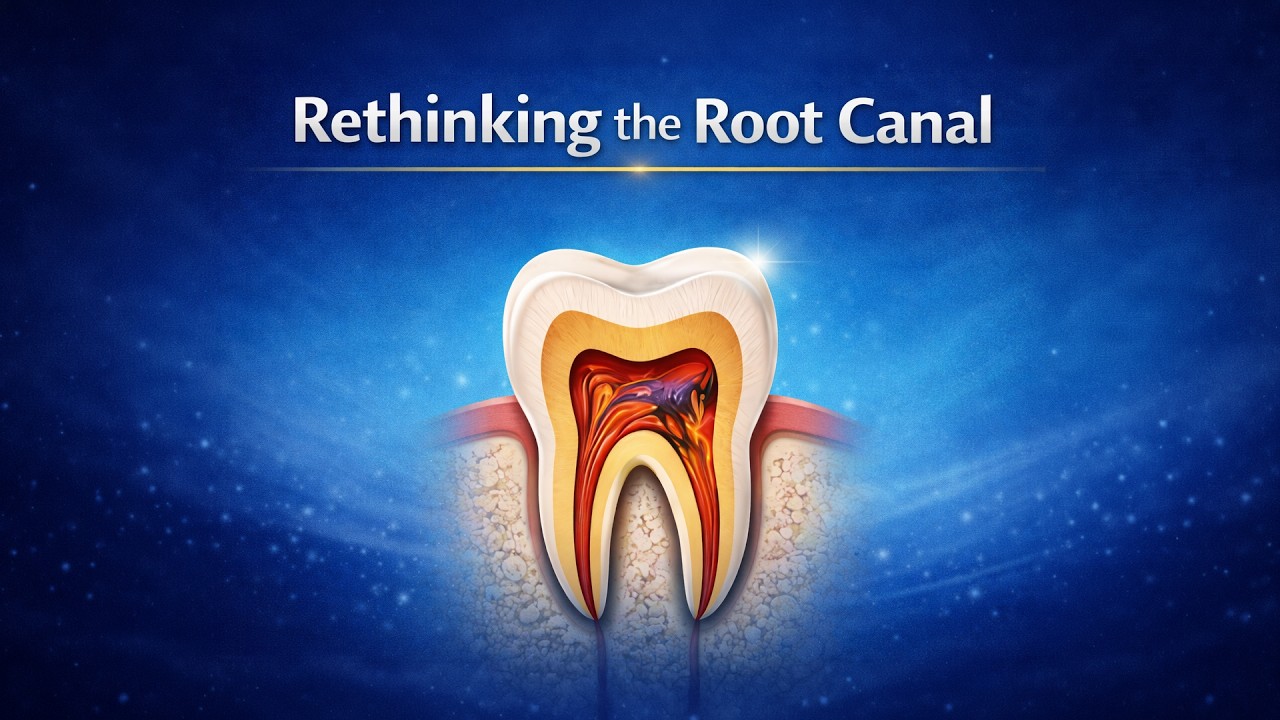
A root canal treatment removes the inner pulp tissue — the nerve and blood supply — cleans the canal, and seals the tooth. The intention is sound, and pain relief is real. But once the pulp is gone, the tooth is dead. It has no blood supply, and without one, it has no immune defence.
What remains is a remarkably complex internal architecture. Dentinal tubules — microscopic channels running the full length of every root — form a network that, in a single front tooth, is estimated to stretch several kilometres if laid end to end.
Bacteria colonise these channels and form biofilms: tightly organised communities that neither the body’s immune cells nor the antimicrobial rinses used during treatment can reliably reach. Research consistently shows that bacteria sheltering deep within those channels can survive thorough disinfection — and that complete sterilisation of the root canal system is, with current methods, practically impossible to achieve.
This matters because a root-canal-treated tooth can continue to harbour low-grade infection without producing any noticeable symptoms. Patients feel nothing. And standard two-dimensional dental X-rays frequently miss what’s there — dentists using three-dimensional cone-beam CT imaging (CBCT) consistently detect significantly more periapical lesions (areas of infection around the root tip) than 2D X-rays taken at the same visit reveal. A tooth that appears fine on a conventional X-ray may look quite different under a more thorough diagnostic lens.
The Oral–Systemic Connection
Here’s where this becomes relevant beyond the mouth. Infected tissue at a root tip doesn’t simply stay put. Bacteria and their inflammatory by-products — including potent toxins that have a strong pro-inflammatory effect on the body — can enter the bloodstream and lymphatic system through surrounding tissue. This can happen during chewing, dental procedures, or even at rest.
Once systemic, these agents contribute to chronic low-grade inflammation. A retrospective cohort study using data from the Baltimore Longitudinal Study of Ageing followed 278 participants for a mean of 17 years and found that the number of teeth with apical periodontitis and root canal treatment was an independent predictor of cardiovascular events — including angina, myocardial infarction, and cardiovascular-related death.
Research involving diabetic patients reveals a relationship that runs in both directions. A review published in the British Dental Journal found that treating chronic oral infection in diabetic patients produced measurable improvements in blood sugar control, with reductions in HbA1c observed within three to four months. The relationship flows the other way too: impaired immunity in diabetic patients makes oral infection harder for the body to contain in the first place.
A comprehensive scientific review published in April 2026 by the International Academy of Oral Medicine and Toxicology, drawing on more than 560 scientific references, consolidates and affirms this pattern across cardiovascular disease, autoimmune conditions, neurological health, and pregnancy complications. The biological mechanism it describes — chronic oral infection as a persistent source of systemic inflammatory burden — is well-supported and increasingly difficult to set aside.
It’s worth being clear about what the research does and doesn’t say. Finding a consistent pattern across large populations is not the same as proving direct causation. The connection is real enough to take seriously, but it does not mean that every root-canal-treated tooth will cause systemic harm.
Who Carries the Most Risk
Every root-canal-treated tooth carries a degree of ongoing risk — that much the research and clinical experience make clear. What varies is how that risk plays out. For someone in generally good health, the body may manage a low-grade infection without it progressing to noticeable systemic consequences, at least for a period of time. For someone already dealing with chronic illness, immune challenges, or systemic inflammation, there is simply less reserve capacity to absorb an additional bacterial burden. The tooth becomes one more demand on a system that may already be stretched.
Where to Go From Here
The practical starting point looks different depending on where someone is in this journey. For a patient weighing whether to proceed with root canal treatment or have the tooth extracted and replaced with a biocompatible alternative, the most useful approach is to have a thorough conversation with a biological dentist—one who considers the whole body, not just the tooth. For someone with a root canal treatment already in place and no symptoms, a 3D CBCT scan can bring genuine clarity — because how someone feels is not always a reliable indicator of what is actually present at the root tip. For a patient managing a chronic condition such as cardiovascular disease, diabetes, or an autoimmune disorder, that conversation carries additional weight, and the diagnostic picture deserves particular attention.
None of this is a reason for alarm. It is an invitation to stay curious, ask good questions, and know that a more complete conversation is available. The mouth and the body are not separate systems — and for anyone who has sensed that connection without quite being able to name it, the emerging research is beginning to offer some answers.